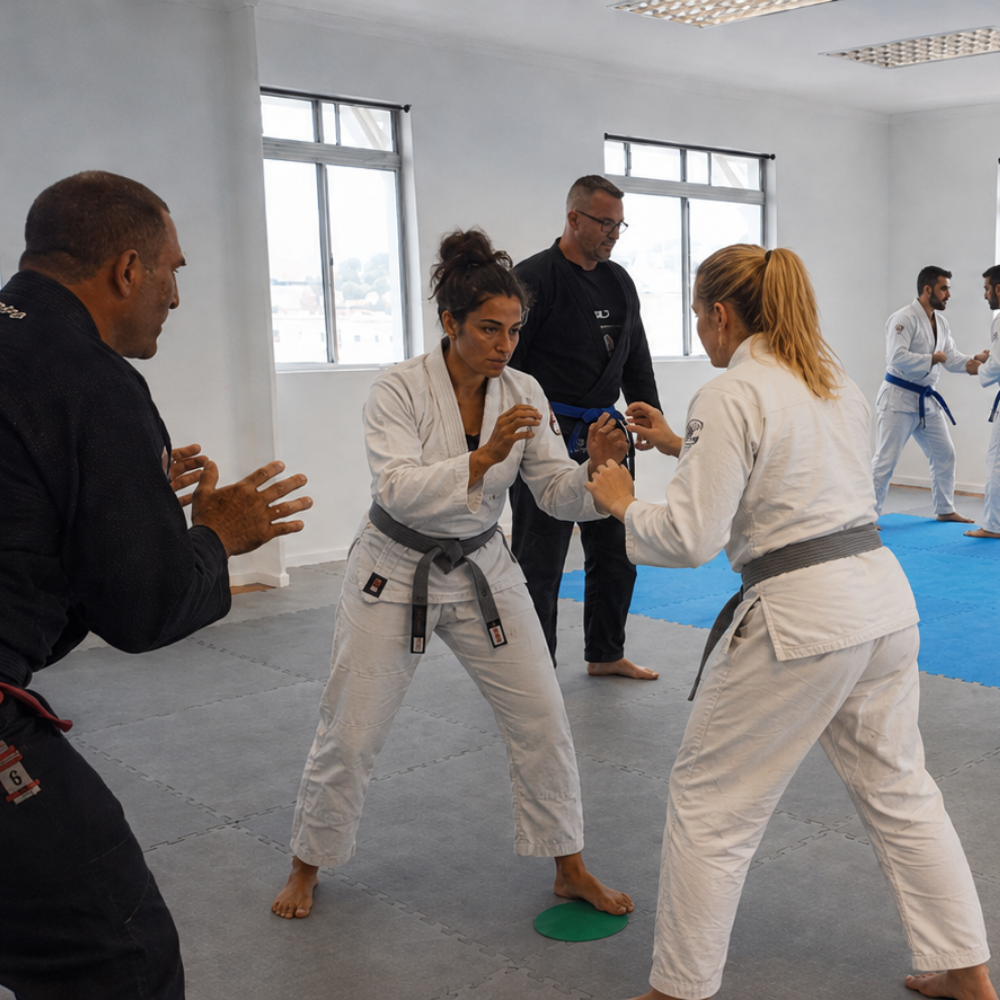
So you’ve decided to take the bull by the horns and sign up for your first Brazilian Jiu Jitsu class. Maybe you’ve already read our beginner’s guide on what to expect in your first Jiu Jitsu class at Maximillian, gone through the checklist, chosen your class, and are eager to get started. As you walk through those doors, you start hearing words you’re not familiar with… shrimping, rolling, base… say what?!
Yes, that’s right, Brazilian Jiu Jitsu comes with its very own set of words, a shared vocabulary that you’ll hear a lot of once you start your training here at Maximillian Jiu Jitsu.
Why Jiu Jitsu Terms Matter
When you’re new to Jiu Jitsu, there’s usually a steep learning curve involved. And it’s not just the physical moves; you’re also learning new words for things, a whole new lingo to describe what’s happening on the mat!
When you first embark on your Jiu Jitsu journey, hearing lots of unknown words may make you feel overwhelmed or even quite lost. Learning some basic Jiu Jitsu terms will help reduce that feeling and make you feel more comfortable.
Learning will also go that much faster when you use and retain a few common Jiu Jitsu terms. You won’t need to keep asking what things mean, which will help make your training go that much smoother.
A shared vocabulary typically connects people and gives them a sense of belonging and camaraderie. When you know some basic Jiu Jitsu terms, it will help you to integrate faster. Before you know it, you’ll be fitting right in and using the lingo like a pro!
Lastly, a very important reason to know some Jiu Jitsu vocabulary is safety. When you use the right words in certain critical situations, they can become very important in preventing injury.
Are you ready? Let’s dive into some of the most important Jiu Jitsu terms!
Jiu Jitsu Terms for Gear and Setup

Before you even get on the mats for your training, you’ll need to dress the part first! For many, this will mean donning a gi (pronounced “gee”), a traditional uniform used in Brazilian Jiu Jitsu. It’s similar to a judo uniform but with tighter cuffs on the jacket and pants. The lapel refers to the thick collar of the gi.

No-Gi refers to the type of training or competition without the traditional gi. It typically involves wearing shorts and a rash guard (similar to a second skin in surfing).
At Maximillian Jiu Jitsu, we offer both gi and no-gi training.
Now that we’ve got you kitted out in the right gear, let’s move on to some action words you’ll likely hear on the mats.
Actions and Concepts in Brazilian Jiu Jitsu
We’ll start by clarifying two very common, broad terms: sparring and grappling. Sparring refers to practicing a fight in a controlled way with a partner. Grappling is the specific type of sparring in which you control your partner without strikes, which is essentially what Brazilian Jiu Jitsu is all about.
Here are a few specific action words:
First up is the term drilling. This means repeating specific techniques with little resistance. The goal of drilling is to improve a specific Jiu Jitsu technique and build muscle memory. Compare this to rolling, which means free practice or sparring. What you learn and practice during drilling can now be applied during rolling. You get to practice your technique with a partner.
Positional sparring is another important concept. It starts from a specific position and limits the grappling to that particular scenario. So you’re sparring, but within limits. At Maximillian Jiu Jitsu, we most often use this technique with beginners to help keep training safe
Let’s move on to the word submission. As the name suggests, this is whichever technique forces your partner to surrender. In Brazilian Jiu Jitsu, this is done by applying a strangle or joint lock technique. When you are on the other side of this, i.e., you need to surrender if you want to avoid getting injured, you will do so by tapping out. Tapping out is arguably one of the most important Jiu Jitsu terms to know, as it prevents injury and keeps our Jiu Jitsu training safe.

Most Common Jiu Jitsu Positions

Throughout your Jiu Jitsu training, you’ll encounter some common positions, starting with the guard, a neutral position where you are on your back and your legs are locked around your partner’s torso. There are many variations of this, such as the full guard, half guard, open guard, etc. For some more in-depth reading on the guard, check out this article.
The mount, on the other hand, is a dominant position where you’re on top of your opponent, sitting or lying on their torso with your knees on either side.
Two more dominant positions are side control, where you’re perpendicular to your opponent, who is lying on their back, and back control, where you’re behind your opponent with your legs wrapped around their waist.
From these positions, you’ll be executing various movements, which we’ll discuss in the next section.
Key Jiu Jitsu Terms for Movements
Let’s start with shrimping or hip escape. This movement describes how someone who is on the ground moves their hips to help create space when being pinned by their sparring partner.
Another very common term is bridging, which is when the hips are used to escape, off-balance, or dislodge your sparring partner’s weight. When a frame or a barrier is created between you and your sparring partner, this is called framing. It helps take some weight and pressure off.
Base refers to your balance and stability, and is about how grounded, balanced and solid you are. It is the opposite of being off-balance.
Lastly, posture refers to having a strong and upright posture and a straight spine. Posture provides a lot of structural strength and stability.
Some Last Words…
Learning the lingo is one thing; using it is quite another. You won’t remember everything at first, and that’s completely okay. Learn as you go, show up, do your thing. Repetition on the mats makes the words easier to understand. The more you hear and use them in training, the more naturally they will stick.
Connecting these new Jiu Jitsu terms to the movements you’re actually doing can help. Over time, the meaning becomes clearer through experience rather than memorisation.
And speaking of last words, or the last word, the word “oss” is a Japanese term that’s used at the end of every Jiu Jitsu training session and is often accompanied by a bow. So, if you remember nothing else from this post, at least you’ll know how to end your first session in style!
For all the newcomers who’ve stumbled onto our page looking for a “Jiu Jitsu near me” or a “Jiu Jitsu Cape Town”, we invite you to stay while! At Maximillian Jiu Jitsu, you’ll find a variety of different classes for adults (including ladies’ classes), ranging from beginners to advanced. We also offer kids’ classes. Or why not just drop by and come and check us out? Sign up for a free trial down below.
Sign up for a free trial today
and experience the difference for yourself.